You make the plan.
Build between waves. Compare range, place defenses, and choose what your budget can do.
 Try an idea
DEFEND · EXPERIMENT · DISCOVER
A curious planet. A lab to protect.
A thousand “what ifs” waiting to happen.
A tower-defense adventure where kids make the plan, watch it work, and discover how to make it better.
Explore the adventureWELCOME TO YOUR OUTPOST
Friendly creatures are approaching your research lab. Pick your defenses, find the right spots, and make a plan with the credits you have. Then launch the wave and see what happens.
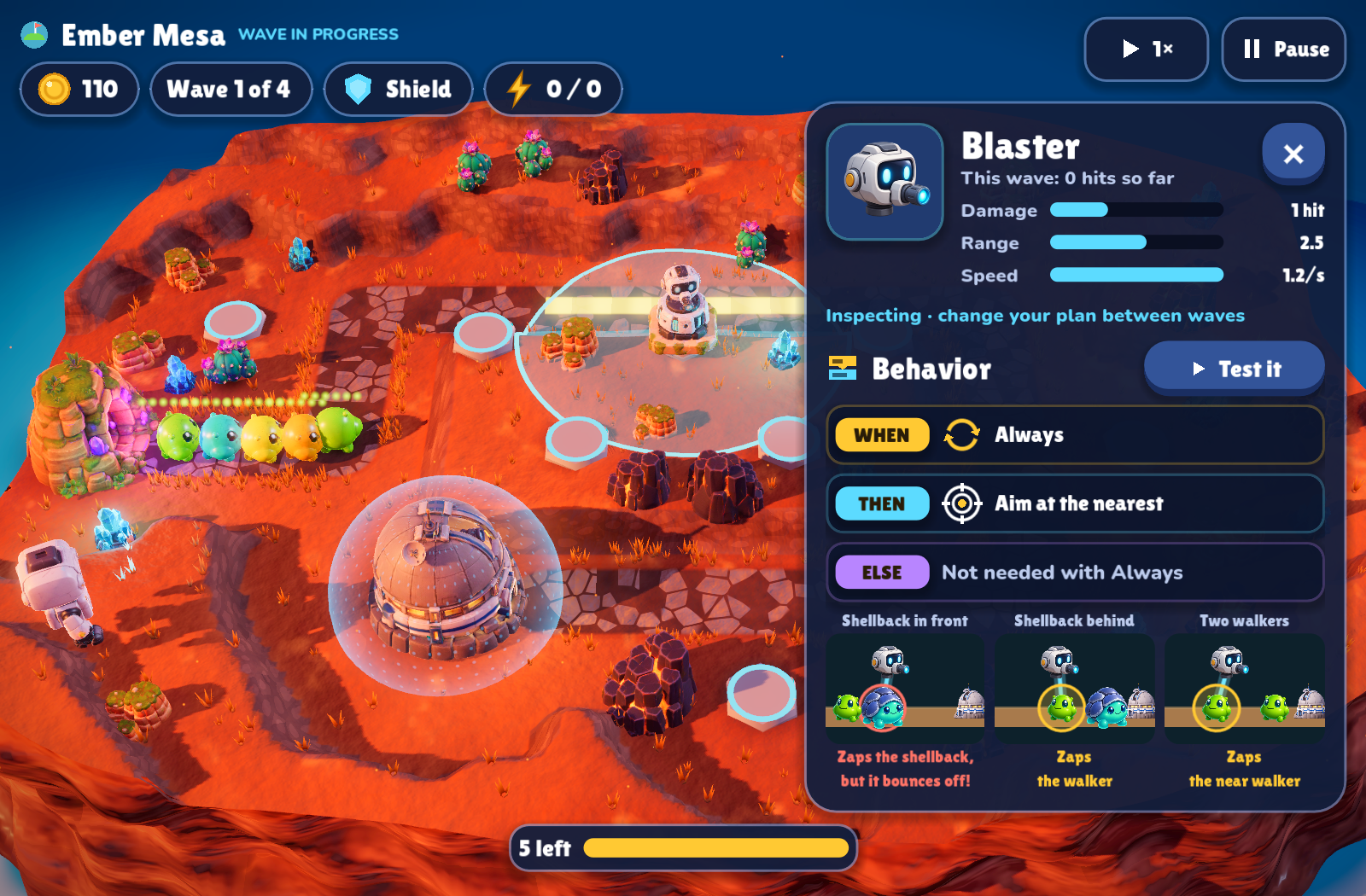
Build between waves. Compare range, place defenses, and choose what your budget can do.
Your towers follow the plan. Pause, inspect, or speed up the action while you watch.
Review what got through and what each tower did. Move, rethink, and try the wave again.
REAL THINKING. REAL PLAY.
Each new tool gives kids a new way to think. Learning grows out of choices and consequences, with a robot sidekick to help them notice what happened.
The same blaster can see more of the path from a different site. Kids compare coverage and discover why location changes firing time.

Limited credits make choices matter. A slow beam can give another defense more time; a laser can reach where a blaster cannot.
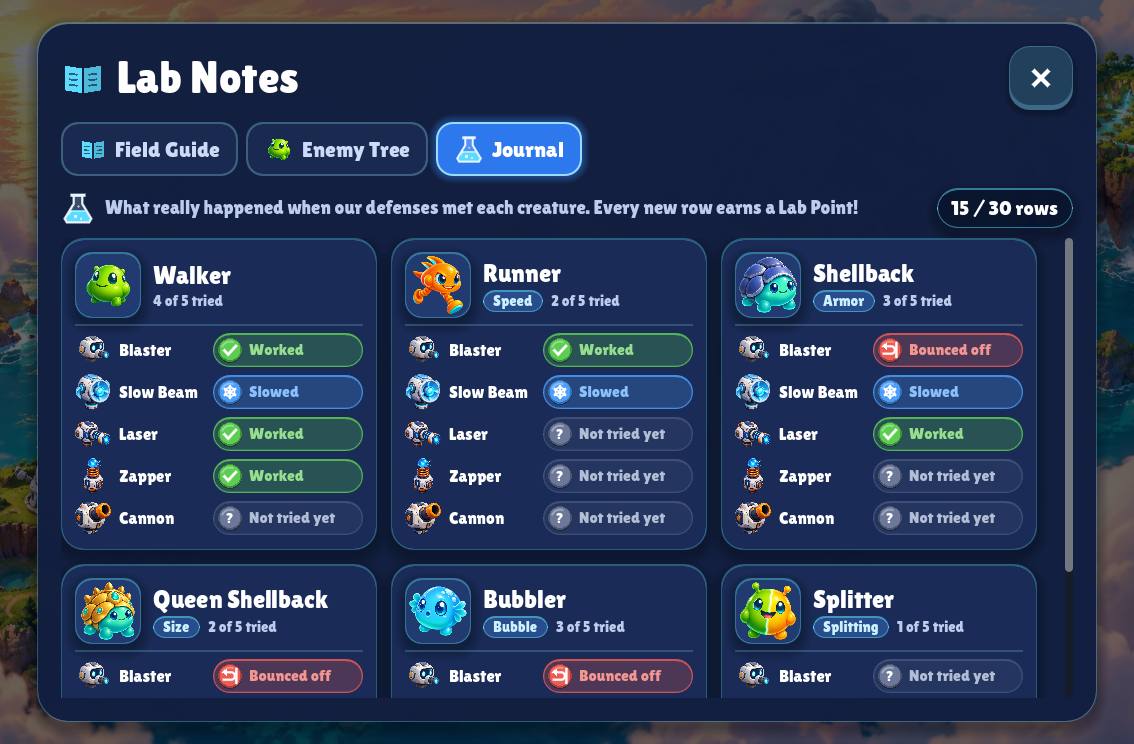
Runners move faster. Shellbacks resist small hits. Kids compare traits and use their observations to choose a response.

Later, generators and relays bring power into play. Kids connect a network and reason about what it can reach and support.
SMALL RULES. SMARTER PLANS.
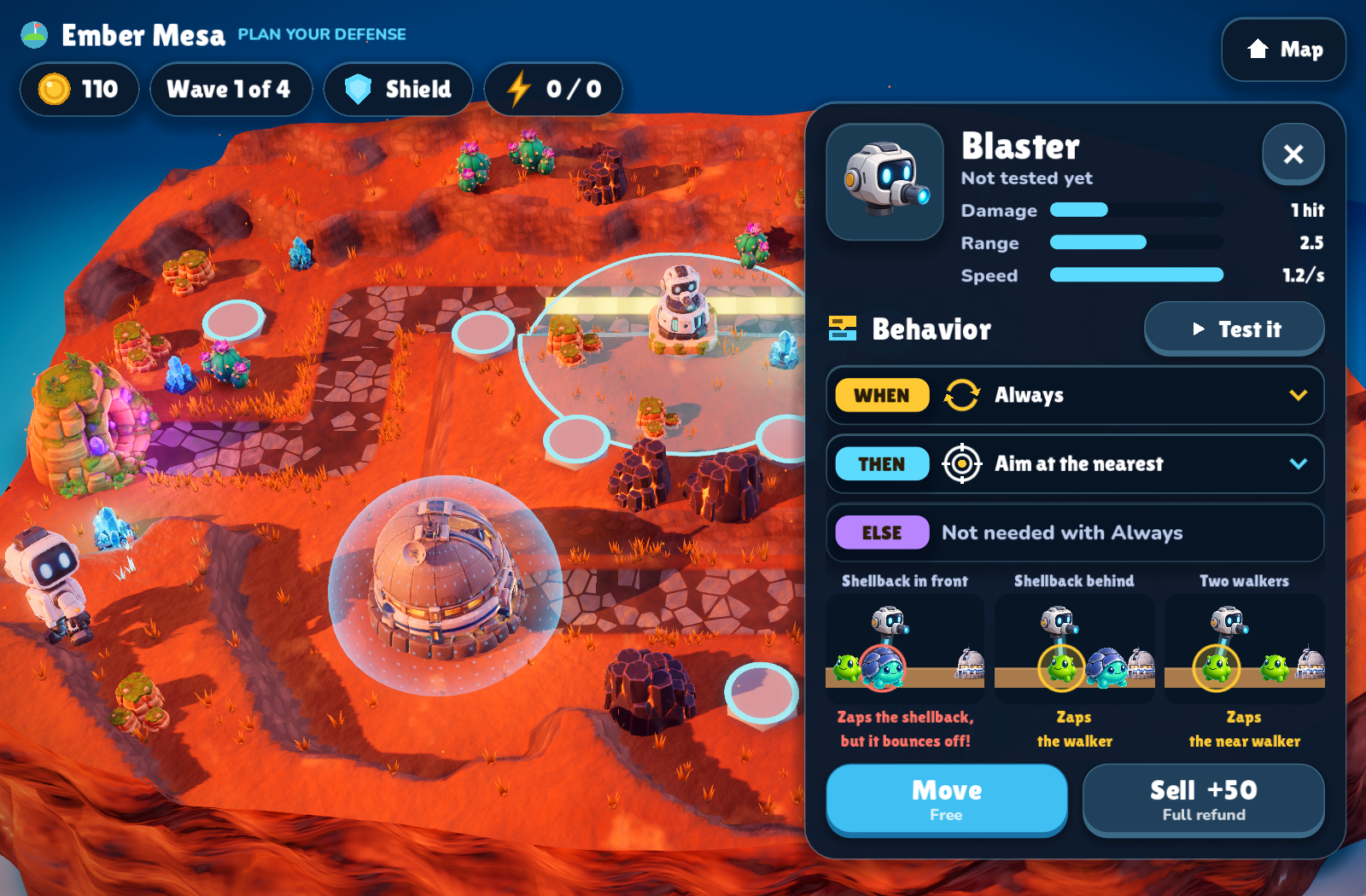
Kids start by learning what their towers do. When faster creatures arrive, simple visual rules give them control over who a defense aims at.
Conditions, actions, and alternatives become useful tools for solving a problem they have already seen. Later, AND conditions and ordered rules add depth.
An example of the kind of rule kids can build. No typing code required.
A LITTLE MISSION. A REAL DISCOVERY.
Two defenses. Five creatures. Can you stop them all? Run the wave, inspect what happened, then write a rule for your Blaster.
A browser challenge inspired by the game’s shellback encounters. This field has a fixed layout and simplified balance.
 ×3×2

Shellbacks have hard shells. Walkers don’t. Let’s see how our defenses handle them.
“HOW DO YOU KNOW?”
In later missions, kids can predict what will happen when a defense meets a new creature. Afterwards, the result is compared with their idea. A checked prediction earns discovery credit even when the guess was wrong.
MEET YOUR NEXT QUESTION
A steady start.
Where can you cover its path?

Twice as fast.
Who should your tower aim at?
A protective shell.
Which hits get through?

A different kind of shield.
What could pop that bubble?
FOR THE GROWN-UPS
Outpost Lab is being built around the curiosity of a nine-year-old: enough challenge to invite thought, with space to inspect, experiment, and improve.
Logic, planning, problem solving, reading evidence, and understanding connected systems. These are opportunities built into play, rather than claims of measured educational outcomes.
Planning happens between waves, without a planning countdown. During combat kids can pause and inspect. Missions target short sessions of around 5–8 minutes, with time to think.
Retry the same wave with the last launched layout and remaining funds. Earlier completed waves stay completed. Between waves, moving is free and selling gives a full refund, so another idea is affordable.
Core missions and progress work offline. The current family prototype has no accounts, ads, or purchases. Public release plans and pricing are still undecided.
Outpost Lab is in development for iOS, with landscape iPad as the primary experience. There is no public download or announced release date yet. Screenshots show the current development build; details may change.
THE ADVENTURE IS STILL TAKING SHAPE
Outpost Lab · An adventure for curious minds.
Take another look